
Tenant boundaries in CX SaaS: identity, access and interaction data
Plan tenant boundaries for CX SaaS across identity, APIs, interaction storage, search, background jobs and deletion, with an illustrative access checklist.
- Published
The short answer
Tenant isolation in a CX SaaS application must follow the interaction, not stop at login. Bind the selected tenant to a verified identity and current membership or service authority, then authorise the action against the resource's ownership and the caller's permitted scope. Carry that boundary through metadata, recordings, transcripts, search, caches, queued work, exports and deletion. Shared, dedicated and hybrid resources can each be appropriate; document the boundary for every data class and test prohibited cross-tenant reads and effects as well as legitimate access.
Define the tenant before choosing its infrastructure
For multi-tenant contact-centre architecture, start with the business and access boundary. A tenant might represent a customer organisation or a separately administered business unit; a queue, brand, hostname or cloud account is not automatically the same thing. Decide which records belong together, who may administer that scope and which explicitly approved sharing relationships exist.
| Concept | Meaning | Boundary to make explicit |
|---|---|---|
| Tenant | An independently governed customer/application scope. | Which data, settings, integrations and administrators belong to it; do not derive authority from a hostname alone. |
| User | A verified human identity. | One person can have memberships in several tenants; selecting one does not grant access to every other membership's records. |
| Membership | The current relationship between an identity and a tenant. | Active state, expiry, permitted teams/queues and how changes invalidate earlier decisions. |
| Role | A named set of permitted actions within an explicit scope. | Agent, supervisor and tenant administrator are not interchangeable; a role name without tenant and resource scope is insufficient. |
| Interaction ownership | The tenant association of an interaction and its derived data. | Recordings, chat turns, transcripts, summaries, attachments, embeddings and exports retain an enforceable ownership association. |
| Service or platform actor | A separately authenticated machine or operations identity. | A worker or support operator needs bounded authority; internal network location and broad credentials are not customer permission. |
A transfer, shared service desk or agency arrangement needs an explicit rule for data ownership and access; it must not silently merge tenants because two records share a phone number or CRM contact. If intentional cross-tenant operations are required, define the authorised identity, tenant set, actions and audit trail separately from normal tenant-local paths. [1]
Compare shared, dedicated and hybrid boundaries without a universal winner
AWS's maintained SaaS Lens describes silo, pool and bridge models. These are resource-sharing choices, not a requirement to adopt microservices, serverless compute or a particular cloud. Compare the options per workload and data class; do not assume a dedicated database also isolates a shared search index, support console or export service. [2][3][4]
| Model | Possible boundary | Engineering trade-off | What still needs testing |
|---|---|---|---|
| Shared / pooled | Shared compute or stores with enforced tenant-aware policy and resource scope. | Can improve utilisation and standardise releases; policy coverage, shared failure impact and tenant-aware capacity controls become especially important. | Every tenant-owned access path, pooled connection, cache, job and aggregate; one tenant's load must not have unbounded access to shared bottlenecks. |
| Dedicated / siloed | Separate tenant resources, credentials or environments for the selected components. | Can reduce the scope of some resource failures; provisioning, upgrades, monitoring, recovery and idle capacity may require more work. | Correct resource routing, shared identity/control-plane access, operator credentials, backup recovery and whether supposedly dedicated dependencies are actually shared. |
| Hybrid / bridge | Some components pooled and others dedicated, based on documented requirements. | Can target isolation where needed but introduces more combinations to provision, observe, migrate and verify. | Every shared-to-dedicated handoff, resource locator and migration; tests must cover each supported combination rather than one preferred tier. |
Separate confidentiality and integrity requirements from availability. Tenant-aware concurrency, queue depth, storage limits and global safety limits address shared-resource exhaustion; they do not replace authorisation. Equally, correct authorisation does not guarantee latency under load. Agree workload, recovery and operating requirements before selecting a topology. A model name alone establishes no residency, certification or compliance outcome. [1][2][3]
Make the trust and access model reviewable
The original model below assumes a compromised ordinary tenant account or browser can change request parameters, object IDs and submitted payloads. It also considers accidental scoping mistakes in shared components and delayed work. It does not assume a tenant can legitimately publish to a trusted queue, and it does not claim to contain a compromised database superuser or unrestricted cloud administrator. Those privileges need their own threat analysis.
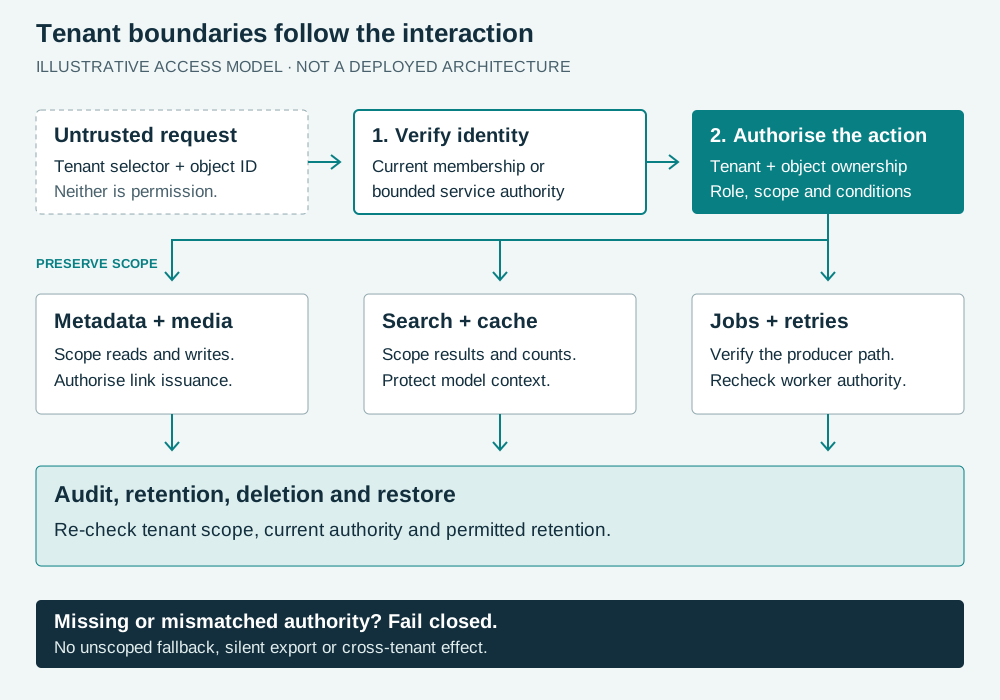
The policy decision needs a verified subject, selected tenant, requested action, resource ownership and applicable scope or conditions. A client-supplied tenant ID is only a selector. A valid session, opaque interaction ID, queue name or successful earlier API call is not a reusable grant to read any recording. Deny missing, ambiguous or disallowed context rather than retrying an unscoped lookup. OWASP makes this distinction between verified context and client-controlled identifiers explicit. [1]
| Actor | Illustrative permitted scope | Not implied by that permission |
|---|---|---|
| Assigned agent | Read permitted fields for an assigned interaction in the active tenant. | Unrelated queues, another tenant's interaction, bulk exports or unrestricted recording downloads. |
| Supervisor | Review the explicitly assigned tenant/team/queue scope under the relevant policy. | All queues by default, cross-tenant supervision or administration of platform-wide services. |
| Tenant administrator | Manage specified tenant settings and memberships. | Automatic permission to play every recording or read sensitive conversation content. |
| Analytics worker | Process the authorised tenant interaction for the stated task through its service identity. | Permission to query every transcript because its database connection happens to allow it, or to reuse material for another purpose. |
| Platform support operator | A separately authorised, bounded tenant/action scope with reason, expiry and audit. | Routine global content access, unrecorded impersonation or permission to delegate the same scope to any caller. |
Treat this table as a starting decision record, not a ready-made role catalogue. Product, security and operational owners must approve the actual matrix, including emergency access and legitimate sharing. The same endpoint may need field-level restrictions and assignment conditions in addition to a role check.
Trace one fictional interaction beyond its first API call
Teaching fixture only: SYN-TENANT-A owns SYN-INT-7 and its derived objects. SYN-USER-1 is an active agent in A with the required assignment, but has no membership in SYN-TENANT-B. B owns a different interaction and media object. These are invented identifiers, not customer records or evidence of any implementation. Replacing A with B in a request must not change the user's authority.
| Stage | Required decision for SYN-INT-7 | Cross-tenant failure to prevent |
|---|---|---|
| 1. API admission and lookup | Verify identity, current membership in A, action and assignment; resolve the interaction within authorised ownership. Check nested IDs and bulk items as well as the top-level route. | A caller selects B in a header, swaps the interaction ID or embeds B's attachment ID under an otherwise valid A request. |
| 2. Metadata and derived writes | Persist enforceable ownership for the interaction, transcript, summary and references. Validate both the existing row and new association on updates; scope joins and writes as well as reads. | A query omits scope, a summary is written to B, or an update changes an A-owned record's tenant without a separately authorised migration. |
| 3. Media and exports | Authorise the exact recording/attachment and operation before reading it or issuing a download capability. Bind an export manifest and its resulting objects to the permitted scope. | A valid metadata response becomes a grant to any storage key, an upload overwrites B's object, or a bulk export includes B's media. |
| 4. Search and retrieval | Apply enforceable tenant and resource permissions to search, snippets, facets, counts, vector retrieval and any context passed to a model. Review ingestion/index ownership too. | The UI hides B's result after the backend has exposed its count, snippet, embedding match or text to an external model. |
| 5. Cache and reused state | Authorise protected reads and key results by every relevant tenant/user/permission dimension; reset request-local and connection-local state appropriately. | The same interaction number, query or cache key serves B's answer to A, or a reused connection retains the previous tenant's scope. |
| 6. Background jobs and retries | Bind A and the target to the authenticated producer path; the consumer re-establishes service authority and the operation's current policy. Scope retry, idempotency and dead-letter state. | An untrusted payload changes tenant, a stale job outlives revoked authority, or a shared idempotency key suppresses or replays another tenant's work. |
| 7. Logs and support investigation | Record minimal permitted identifiers, action, decision and outcome with verified tenant context. Restrict tenant-scoped audit reads and separately authorise platform investigation. | A denial logs the recording URL or transcript, a tenant can search B's audit events, or operator access silently becomes unrestricted. |
| 8. Retention, deletion and restore | Authorise the request and object set, apply approved retention/hold rules, track derived copies and invalidate or constrain replay. Report partial, blocked and completed states accurately. | A deletion affects B, an index/export survives contrary to policy, or restoring a shared backup reintroduces another tenant's data or revoked access. |
This trace is a design exercise, not a claim that the checks exist or pass in production. OWASP's guidance specifically covers verified tenant context, object access, caches, authenticated asynchronous work, storage, audit access, offboarding and tenant-scoped restores. Search/vector and model-context checks here are applications of those ownership principles, not a claim that a particular search or AI service enforces them automatically. [1]
Use data-layer controls without assuming they cover every path
For a shared relational design, an enforceable ownership association, constrained database roles and row-level policies can add defence in depth. Other designs may use separate databases or credentials rather than a tenant column. An ORM filter alone is not complete coverage: raw queries, joins, bulk operations, relationship loading, migrations and administrative jobs need explicit review. [1]
Version-pinned example: PostgreSQL 18 documents that enabling row security with no applicable policy produces default deny for ordinary row access. It also documents important exceptions: superusers and BYPASSRLS roles bypass policies; owners normally bypass them unless FORCE ROW LEVEL SECURITY applies. FORCE does not constrain superusers or BYPASSRLS. TRUNCATE and REFERENCES are not covered by row security, and referential-integrity checks can create information channels. Review policy combinations and both visible and newly written rows—not just one successful SELECT. [5]
If a policy depends on a tenant setting, that setting must originate from verified authority; a database parameter does not authenticate a caller. PostgreSQL 18 distinguishes session-level SET from transaction-local SET LOCAL. Re-establish the intended context inside each relevant transaction and test reused connections, rollback and missing context through the actual request role and pooling mode. Do not assume a borrowed connection starts clean or that a transaction-local value eliminates a pre-existing session value. [1][6]
These are documentation constraints, not deployment SQL or a recommendation to use PostgreSQL. Security reviewers still need to inspect the selected engine/version, grants, policy expressions, privileged paths and real runtime configuration. A policy test performed only as the database owner is not evidence that the ordinary application role is correctly isolated.
Treat media links as capabilities, not harmless URLs
A tenant-prefixed storage key is useful organisation, not authorisation by itself. Check the exact object, operation and ownership before proxying content or issuing a signed link. Keep capabilities narrowly scoped, avoid logging them and define the required lifetime and revocation behaviour. An attachment belongs to the same access analysis as the transcript or recording. [1]
Provider-specific example: Amazon S3 describes presigned URLs as bearer tokens. They can be reused until expiry, subject to the signing credentials and applicable policy. Removing application membership does not by itself make an already issued URL perform a fresh application membership check. S3 checks expiry when the request starts; a download started before expiry can continue afterward. Do not promise instant revocation or a single-use link from an ordinary presigned URL. [7]
If the requirement is current membership on every media request, evaluate an authorised proxy or other reviewed access design, including range requests and delivery behaviour, rather than assuming short expiry is equivalent. The design choice must account for availability, performance and the actual provider contract; this article implements neither option.
Carry ownership through jobs, diagnostics and the data lifecycle
A trusted queue is not proof that every message targets an authorised tenant. Classify work as tenant-scoped, global or explicitly cross-tenant, authenticate the producer/broker path and authorise the target operation at consumption. Decide whose authority a delayed job represents. User-delegated work may need current membership; a legitimate retention service may instead act under its own approved service policy. Neither should inherit unrestricted authority from the worker's broad connection. [1]
For logs, separate tenant-visible audit records from platform diagnostics. Prefer minimal identifiers and outcomes over transcripts, sensitive fields, bearer links or tokens; protect identifiers too. A central audit store can be appropriate if its readers are scoped, platform access is separately authorised and retention is defined. Tenant context in a log line does not itself restrict who can read it. [1]
For deletion and offboarding, inventory active rows, object versions, search/vector indexes, caches, exports, replicas, backups and queued/replayed work. Responsible owners must determine permitted retention and holds; this guide gives no universal legal period. Distinguish accepting a request from removing active copies and from final backup expiry. Restrict retained material and record failures rather than claim immediate erasure everywhere. [1]
Restoring one tenant from a shared backup requires a scoped recovery plan, not overwriting live shared data with an old snapshot. Validate the target ownership and current access/retention rules before returning recovered records to service. Test that deleted or restricted material is not silently resurrected by restore, retry or re-indexing. [1]
Test prohibited reads and effects, not just the happy path
The original checklist below is proposed review coverage, not a completed penetration test or an approved release gate. Use two independently scoped test tenants with distinct content and least-privileged actors in an authorised non-production environment. For each prohibited attempt, inspect responses, writes, generated objects, jobs and minimal audit evidence—not only the HTTP status. Also exercise permitted same-tenant controls so a blanket denial cannot masquerade as correct isolation.
| Attempt | Expected boundary | Evidence to examine |
|---|---|---|
| Missing or forged context | No tenant-scoped operation without verified identity and authorised tenant selection; no default/global fallback. | Change tenant header, path, body and token/session selection independently; no data or effects for B. |
| Swapped and nested object IDs | A's caller cannot read, update or delete B's interaction, attachment or derived record. | Direct, nested and bulk routes, including mixed A/B items; no B content or unintended B mutations. Define batch atomicity explicitly. |
| Same tenant, wrong role or assignment | Membership alone does not grant supervisor, export, recording or unrelated-queue access. | A denied restricted action and a permitted assigned-agent control, with field and team/queue restrictions. |
| Derived writes and ownership changes | New summaries, joins and updates cannot attach A's operation to B or silently reassign ownership. | Insert/update effects and referenced-resource checks, not just filtered reads. |
| Pooled connection or cache collision | B's prior context or result cannot affect A's request. | Alternate tenants on reused connections; missing context, rollback, repeated IDs, permission changes and cached results. |
| Search, counts and model context | No unauthorised B text, snippets, facets, counts or retrieved context escapes the boundary. | Backend result set, aggregates, pagination and any model request—not merely what the page displays. |
| Object keys, uploads and exports | No cross-tenant read, overwrite or exported object; authorised manifests remain scoped. | Tampered object references, upload target and export contents, plus same-tenant permitted control. |
| Copied or expired media capability | Observed bearer-link behaviour matches the documented lifetime and revocation design; no claim of automatic membership re-check. | Reuse, expiry, revoked application membership and any selected proxy policy; distinguish an existing authorised capability from an unauthorised issuance. |
| Forged, stale or replayed work | No unverified tenant override, stale delegated permission or cross-tenant deduplication effect. | Producer authentication, consumer policy, revoked membership, tenant-scoped retry/dead-letter state and duplicate keys. |
| Support and audit access | A tenant admin cannot become a platform auditor; support scope is explicit and bounded. | Audit queries, restricted operator actions, expiry and absence of conversation content, tokens or bearer links in logs. |
| Retention, deletion and restore | No B deletion, silently retained active copy or unauthorised resurrection outside the approved policy. | Affected-object inventory, hold/partial-failure status, index/export cleanup and a one-tenant recovery from a two-tenant backup. |
| Shared-resource exhaustion | Tenant and global limits bound queued work, concurrency and other chosen bottlenecks without granting extra data access. | Approved load/abuse tests against agreed limits; rate-limit correctness is separate from authorisation correctness. |
| Unclassified new access path | A new table, object class, index, export or worker cannot bypass the reviewed ownership model unnoticed. | Schema/resource inventory and actual request-role coverage; include privileged bypass paths in a separate review. |
Use a reviewed error policy that avoids unnecessary existence disclosure; a 404 or 403 alone is not proof that storage, jobs or logs were unaffected. Where sharing or platform operations are intentional, test their exact permitted scope and denial outside it. Record failed, blocked and untested cases honestly. An article rendering test or a synthetic diagram cannot substitute for these platform checks.
Make tenant isolation a change-review concern
- Before architecture selection: agree tenant meaning, data ownership, legitimate sharing, actor/action matrix, workloads and operating constraints.
- Before implementation approval: map every tenant-owned store and access path, including media delivery, search, workers, exports, logs and recovery.
- Before a release: review the selected identity/cloud/database versions and real roles, execute approved positive and negative checks, and retain reviewable evidence.
- After a new data class, role, integration or migration: revisit ownership and cross-tenant paths; do not assume the old checklist covers new resources.
- After a permissions, pooling, signed-link, job or restore change: reassess stale authority, reused state and derived copies.
- For continuing review: assign a security owner, document exceptions and recheck this guidance at least every 180 days or sooner after material platform/security changes.
Strong CX engineering makes these decisions explicit and testable across the application lifecycle. This guide sets out questions and an illustrative model; it does not certify an architecture or promise that a particular product already implements it.
Limitations
This is an illustrative architecture guide, not a description or security assessment of an icommunix or partner deployment. All tenants, people, interaction identifiers and access examples are fictional. The proposed model and negative-test checklist have not been executed against a real CX platform and do not prove isolation, regulatory compliance or resistance to privileged compromise. PostgreSQL 18 is a pinned documentation example, not a statement about a deployed database. Sources were checked on 30 October 2026; implementation-specific identity, cloud, database, retention and security decisions require qualified review.
References
- [1] OWASP — Multi-Tenant Application Security Cheat Sheet: context, data, caches, jobs, storage and offboardingAccessed
- [2] AWS Well-Architected SaaS Lens — Silo isolation and operational trade-offsAccessed
- [3] AWS Well-Architected SaaS Lens — Pool isolation and shared-resource trade-offsAccessed
- [4] AWS Well-Architected SaaS Lens — The bridge modelAccessed
- [5] PostgreSQL 18 documentation — Row Security Policies, bypass roles and limitationsAccessed
- [6] PostgreSQL 18 documentation — SET and transaction-local configurationAccessed
- [7] Amazon S3 User Guide — Presigned URL permissions, bearer access and expirationAccessed
Resources
Planning tenant and access boundaries for a CX application?
Discuss your users, data and operating requirements with our team. Start with a non-sensitive outline of the application and intended access—not recordings, customer records, security configurations or credentials.